 Your browser is out of date. For best experience switch to latest updated Browser.
 Get Chrome
 Get Edge
 Get Firefox
Ability Levels
Categories
Resource Types
Age/Grade Range
CCSS
Anchor Standard
Speaking & Listening
Language
Reading

Self-Advocacy - Selecting Preferential Seating
$ 095
Do students know how to select a seat in different settings? Use this to plan activities for students to determine what is and is not good place to sit in various situations.

Bluffing - Guidance for Student Discussion
$ 075
This information provides teachers and families ideas for how to discuss bluffing with children who are deaf or hard of hearing. Children often resort to bluffing, or pretending that they understood,
...
when they lack strategies for how to repair a communication breakdown. Guides discussion, not a worksheet. From Building Skills for Success in the Fast-Paced Classroom.

Elephant in the Room
$ 9
Skyler has a hearing loss. And he doesn’t feel much like talking today. No wonder—he keeps missing what his parents and siblings have to say, and it’s frustrating. Skyler’s little sister, Maizy, tags
...
y, tags along on his morning routine and, with the help of her special friend, we learn that it takes more than hearing aids to help Skyler feel like talking again.This 35-page full color children’s book by Audiologist Jim Bombicino provides avenues for discussion and building vocabulary by highlighting the difficulties that students may face each day, including mishearing and misunderstanding information, the effect of background noise, and consequential frustration and confusion that can happen when the ease of daily communication is taken for granted by typically hearing persons. In this case, the story follows a young boy as he awakens and prepares for a typical school day.The e-book version includes audio of the text read by actors, while their voices are filtered to imitate how Skyler hears through his hearing aids! Listening situations include a speaker with added background noise, simultaneous speakers, a speaker talking too quickly, and mishearing words—all heard as they come through Skyler’s hearing devices. Perfect for helping teachers, families, and classmates understand what a hearing loss might be like. Finally put typically hearing adults and children in the shoes of the child with hearing loss!Please note: Compatible only with iPad and iOS devices. Free Author’s notes and discussion guide are available for download at Teacher Tools Takeout marketplace.How to Open ePub Files on Your iPad.Before trying to load the ePUB file make sure you have downloaded and installed iBook app from Apple’s app store.Directly on the iPAD or Iphone (recommended)1. Make sure the free iBooks app is on your iPad.2. Follow the link from Safari to reach the ePub document. This means either accessing your email to find the attached file, or going to our website to download the file with an access code.3. Select “Open in iBooks” on the iPad/iPhone4. The eBook will open and be added to your iBooks collection.5. From now on, you can open the ePub document from the iBooks app on your iPad/iPhone.From PC to iPAD1. Make sure the free iBooks app is on your iPad.2. Make sure the free Itunes app is on your PC. Open iTunes.3. Find the ePub file on your computer by accessing email or visiting website where purchased/obtained.4. Drag and drop the ePub file onto your Library in iTunes on your computer.5. Connect your iPad to your computer.6. Check under the “Books” tab in iTunes to be sure this ePub is selected for syncing7. Then sync.8. The ePub document is added to your iBooks collection inside the iBooks app.9. From now on, you can open the ePub document from the iBooks app on your iPad.Directly on PCHow to read Open EPUB or Open PDF e-books on a computer1. Download the free Adobe Digital Editions: https://www.adobe.com/solutions/ebook/digital-editions/download.html2. Open Adobe Digital Editions (ADE) on your Windows or Mac computer.3. Go to File > Add to Library.4. Find the saved EPUB or PDF file on your computer. By default, files are saved to your computer’s “Downloads” folder.5. Double-click an e-book to start reading, or follow these steps to transfer it to an e-reader.
Self-Advocacy and Accommodations - Supporting Access for Students with Hearing Loss
$ 0
Information to be considered by DHH teachers and school teams listing possible accommodations and self-advocacy expectations in the areas of a) communication access, b) communication interaction, c) a
...
dditional supports, d) special considerations.

Advocacy In Action Curriuculum guide, worksheets, and Assessment tracker for Middle School - BUNDLE
$ 1695
Complete curriculum guidance, fillable sheets, activities and scenarios for instruction in understanding hearing loss (in themselves and other role models), assistive devices, and social awareness si
...
tuations. Also includes a a pre and post assessment skills tracker that can be used to determine strengths and needs, track skill acquisition, and create goals and objectives. Includes items 0527-0531, 0535, 0539, 0479, 0477

Five Point Response Scale for LIFE-R or Other Listening Tasks
$ 0
Visual of 5 response choices with face images reflecting level of challenge. Can be used with LIFE-R checklist or when discussing level of listening challenge with language-limited children.

Auditory Memory and Recall Lickety- Split Game
$ 5
Lickety Split is a fast-paced barrier game played swiftly back and forth between two players that target auditory word recall, challenges auditory memory and processing speed.Improvement in the child’
...
d’s ability to listen, remember and recall results in following more complex instructions, understanding detailed conversations, and learning new information.IDEAL FOR: Listening & Spoken Language, Auditory Verbal, Deaf & Hard of Hearing, Speech, ELA, Teletherapy, Distance Learning, Face to Face, Digital, Print...Children that are deaf and hard of hearing with reduced auditory memory abilities may struggle to recall longer sentences, only remember part of what was said and find it hard to recall information they were told in the past and relate it to new learning. Memory boosting strategies and playing games like Lickety Split can boost a child’s spoken language, communication, literacy and academic skills.See my blog post on how I used the Lickety Split Game in teletherapy.Click HEREINCLUDES:➼ 3 sets of colorful and engaging game boards➼ Guidance for children with hearing loss➼ Listening and Spoken Language Tips➼ Terms of Use (see below)Teletherapy, Distance Learning & Face to Face✢ DIGITAL - NO PRINT can be opened and played with your favorite PDF reader app on a tablet. When playing on a computer, open and use a PDF reader such as Adobe Acrobat Reader DC which is free.✢ Use in Easel by TpT for digital resources✢ Print and play face to face or in a small group or classroom
Steps to Success Worksheets
$ 35
A
companion piece to the Steps to Success Curriculum (ID# 1305), this bundle of
65 fill-in worksheets provided students with practice in key advocacy skills,
reading activities on both a basic and
...
advanced level and real-life language
development. The use of real photos, graphs and visual organizers support
retention of information and hold student’s interest. Goal area worksheets
address the following topics: 1. Understanding the science of hearing 2. Using
technology 3. Developing language processing skills 4. Self knowledge 5. Social
interaction and language 6. Practicing self-management 7.
Understanding rights and access 8. Accommodations and advocacy. Supplemental expansion worksheets for each goal are also available. See ID # 0740 - 0748.
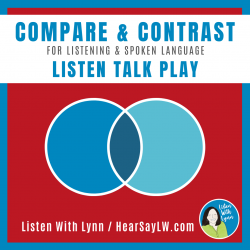
Listening & Language Compare and Contrast Activity
$ 4
Listening & Language Compare & Contrast targets listening, growing vocabulary, descriptive language skills, critical thinking, two-way conversations and help develop reasoning skills in identifying si
...
ng similarities and differences.Comparing and contrasting is a powerful prerequisite for learning language skills that lead to using compound and complex sentences.IDEAL FOR: Listening & Spoken Language, Auditory Verbal, Deaf & Hard of Hearing, Speech, ELA, Early Intervention...INCLUDES:➼ 2 Kid-Friendly Venn Diagram Sorting Mats➼ 1 Compare and Contrast Modeling Sheet➼ Compare & Contrast LSL Plan Activity➼ Talking Points➼ Guidance for children with hearing loss➼ Listening and Spoken Language Tips➼ Terms of Use (see below)This resource is a LISTEN, TALK AND PLAY interactive play activity that uses small manipulative toys or household items. Small manipulative toys are not included but one example of these little toys is included.

Lesson 8 - Negotiating with Others
$ 0
Lesson 8 - Negotiating with Others. This lesson gives students some basic information about negotiation: how to recognize when negotiation is necessary, how to negotiate fairly, and how to negotiate e
...
ffectively. By Kris English.

 Cookies